If you edit 4K or higher-resolution footage, the right enclosure can make a real difference in offload speed, cache performance, and day-to-day reliability.
Our picks focus on the best SSD enclosures for video editing, prioritizing fast interfaces, solid thermal control, and creator-friendly features.
Best 10 SSD Enclosures for Video Editing Picks for 2026
High-Bandwidth Premium
UGREEN 80Gbps M.2 NVMe SSD Enclosure

- Up to 7,000 MB/s claimed speed
- Dual-chip controller for stable transfers
- Advanced cooling with aluminum fins
Best For: Power users moving huge video files who want maximum single-drive throughput
Multi-Drive Workhorse
TERRAMASTER D4 SSD NVMe Enclosure

- Holds four NVMe drives up to 32TB
- 40Gbps performance for 4K editing
- Active cooling with hot-swap support
Best For: Editors who need large external NVMe capacity for projects and backups
Mobile Creator Pick
ACASIS 10Gbps Magnetic M.2 NVMe SSD Enclosure

- Magnetic mount for quick attachment
- Supports 4K@60 ProRes recording on compatible iPhones
- Built-in fan and thermal pad for cooling
Best For: Creators filming on iPhone who need magnetic, portable SSD storage
Ultra-Fast Thunderbolt Pick
Yottamaster 40Gbps Tool-Free NVMe Enclosure

- Thunderbolt 4 and USB4 at 40Gbps
- Built-in fan and ASM2464PD controller
- Tool-free install with transparent cover
Best For: Editors who need fast, simple external NVMe storage for 4K workflows
Quiet 10Gbps Workhorse
Plugable Tool-Free USB-C NVMe Enclosure

- 10Gbps USB 3.2 Gen 2 with UASP/TRIM
- Auto fan plus aluminum cooling
- Tool-free setup with USB-C and USB-A cables
Best For: Editors who need a dependable everyday enclosure for transfers and backups
Pro Thunderbolt Cooling Choice
ACASIS 40Gbps Fan-Cooled NVMe Enclosure

- Thunderbolt 4/3 and USB4 support
- Active fan plus aluminum heat dissipation
- Compact build with strong tested speeds
Best For: Mac and PC editors who need fast external storage with better thermal control
Turbo 40Gbps NVMe Pick
UGREEN 40Gbps M.2 NVMe Enclosure
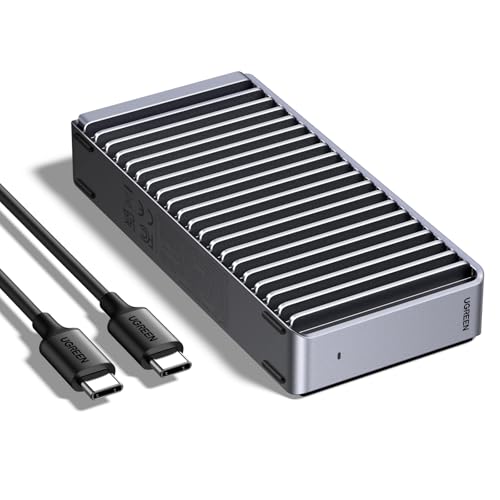
- Up to 3600MB/s with USB4/TB4 setups
- Fanless double-sided fin cooling design
- Supports NVMe drives up to 8TB
Best For: Fast portable editing and large-file transfers
Quiet Studio Runner-Up
ACASIS 40Gbps M.2 NVMe SSD Enclosure

- Fanless aluminum fins keep noise low
- USB4 and Thunderbolt 5/4/3 compatible
- Up to about 2700MB/s real-world speed
Best For: Quiet studio editing and Mac-focused workflows
High-Capacity Creator Choice
Satechi USB4 NVMe SSD Pro Enclosure

- Up to 16TB capacity for large libraries
- USB4 40Gbps with up to 3840MB/s claimed
- Tool-free install and broad drive-size support
Best For: Large project libraries and travel-friendly editing
USB4 Speed Pick – SABRENT USB4 NVMe SSD Enclosure, Tool-Free
For ssd enclosures for video editing, this SABRENT model is a strong choice if you want fast offload times and a simple setup. It supports PCIe NVMe drives only, delivers up to 3,900 MB/s over USB4, and stays plug-and-play on Thunderbolt 3/4, USB4, and USB-C systems.
Best For: Editors who want a compact, tool-free NVMe enclosure for fast transfers on modern USB4 and Thunderbolt laptops.
Pros:
- Up to 3,900 MB/s over USB4, with 2,700 MB/s on Thunderbolt 3/4
- Tool-free install works with 2230/2242/2260/2280 PCIe NVMe drives
- Active cooling fan and aluminum/ABS build help maintain performance
- Compatible with Windows and macOS, with no driver or external power needed
Cons:
- Does not support SATA M.2 SSDs
- Best performance depends on a USB4 or Thunderbolt host
If your workflow is built around quick project transfers and portable editing storage, this enclosure focuses on speed and ease of use rather than multi-drive capacity. It is a practical pick for creators using modern laptops and a compatible NVMe SSD.
High-Bandwidth Premium – UGREEN 80Gbps M.2 NVMe SSD Enclosure
When you need ssd enclosures for video editing that prioritize raw speed, this UGREEN enclosure stands out with an 80Gbps design and claimed transfer speeds up to 7,000 MB/s. Its dual-chip layout and enhanced cooling make it aimed at heavy file movement and stable performance during long work sessions.
Best For: Editors who want top-tier transfer speed and strong thermal control for large media files.
Pros:
- Dual-chip design with Intel JHL9480 and JMicron JMS583 controllers
- Claims speeds up to 7,000 MB/s
- 3D cooling design uses double-sided aluminum fins for better heat dissipation
- Supports 2230/2242/2260/2280 NVMe drives up to 8TB
Cons:
- Not compatible with SATA (NGFF) or mSATA SSDs
- Does not support SSDs with pre-installed heatsinks
This is the most performance-focused single-drive option in the group, especially if you are moving large project files and want a slim enclosure with extensive host compatibility. It is built for speed first, but only with compatible NVMe drives.
Multi-Drive Workhorse – TERRAMASTER D4 SSD NVMe Enclosure
For ssd enclosures for video editing, this TERRAMASTER unit is built for bigger timelines and larger libraries rather than just quick shuttle storage. It holds four M.2 NVMe drives, runs over 40Gbps USB-C, and is explicitly positioned for 4K video editing and large file transfers.
Best For: Editors who need multi-drive capacity and a fast external workspace for active projects and backups.
Pros:
- Supports four M.2 NVMe 2280 SSDs for up to 32TB total capacity
- Up to 3,224 MB/s with four drives, or 1,608 MB/s with one SSD
- Active cooling with temperature-controlled fans and four internal sensors
- Tool-free access and hot-swappable drive changes
Cons:
- No built-in RAID, so any RAID setup requires third-party tools
- Requires external power and is larger than a single-drive enclosure
If your edit station needs room for multiple NVMe drives, this enclosure offers the storage scale and cooling to support demanding workflows. It is especially useful for editors who want one box for project storage, backups, and fast access.
Mobile Creator Pick – ACASIS 10Gbps Magnetic M.2 NVMe SSD Enclosure
Among ssd enclosures for video editing, this ACASIS model is the most mobile-focused option here, especially for iPhone-based ProRes workflows. It combines a magnetic mount, 4K@60 HDMI support, and a built-in cooling fan in a compact enclosure designed for creators working on the go.
Best For: Mobile editors and videographers who want direct iPhone ProRes recording and easy attachment.
Pros:
- Magnetic attachment makes it easy to mount and secure
- Supports direct 4K@60 ProRes recording with compatible iPhone 15/16/17/18 Pro models
- Built-in silent fan plus aluminum alloy and thermal pad for heat dissipation
- Compact 2230 NVMe form factor is easy to carry
Cons:
- Only 10Gbps, so it is slower than higher-end USB4 or Thunderbolt options
- Requires formatting to ExFAT or APFS before use with a new SSD
- May need external power for larger SSDs or multiple devices
This enclosure makes the most sense when portability and phone-based recording matter more than top-end desktop transfer speeds. For travel, event capture, and mobile content creation, it offers a very specific and practical workflow.
Ultra-Fast Thunderbolt Pick – Yottamaster 40Gbps Tool-Free NVMe Enclosure
If you want one of the faster SSD enclosures for video editing, this Yottamaster model is built around Thunderbolt 4 and USB4 for high-throughput work. It supports M.2 NVMe drives in 2230, 2242, 2260, and 2280 sizes, and the built-in fan plus ASM2464PD controller are aimed at keeping performance steady during sustained transfers.
Best For: Editors who want a tool-free 40Gbps enclosure for fast media offloads and 4K workflows.
Pros:
- 40Gbps Thunderbolt 4/USB4 support with real-world sustained speeds listed around 2800 to 3200 MB/s
- Tool-free, three-step installation with a clear transparent cover
- Built-in active cooling and overcurrent/overheating protection for heavier workloads
- Supports common NVMe sizes up to 2280 and drives up to 8TB
Cons:
- Best performance depends on a 40Gbps-rated cable and a compatible host
- Speed can vary based on SSD, system, and file conditions
This is a strong fit if your workflow prioritizes speed and convenience over budget. For editors moving large footage libraries or working directly from external storage, it offers the kind of headroom that makes day-to-day editing feel smoother.
Quiet 10Gbps Workhorse – Plugable Tool-Free USB-C NVMe Enclosure
Among SSD enclosures for video editing, this Plugable option is a practical 10Gbps choice for everyday transfers and project storage. Its RTL9210 chipset, aluminum body, and dual cooling approach are designed to maintain stable throughput while keeping temperatures in check during longer file moves.
Best For: Editors who want a reliable, quieter USB-C enclosure for routine media transfers and backup drives.
Pros:
- USB 3.2 Gen 2 10Gbps support with UASP and TRIM
- Dual cooling system combines an auto fan with aluminum heat dissipation
- Tool-free, driver-free setup with both USB-C and USB-A cables included
- Wide OS compatibility across Windows, macOS, Linux, and Android
Cons:
- Does not support SATA NGFF SSDs
- Slower than 40Gbps enclosures for the largest media transfers
This enclosure makes sense if you want stable, general-purpose performance without stepping up to Thunderbolt pricing. It’s especially appealing for editors who value quiet operation, broad compatibility, and a straightforward setup.
Pro Thunderbolt Cooling Choice – ACASIS 40Gbps Fan-Cooled NVMe Enclosure
If your editing workload pushes storage hard, this ACASIS 40Gbps enclosure is built for sustained performance. It uses the Intel JHL7440 chip, supports Thunderbolt 4 and Thunderbolt 3, and adds an active cooling fan with heat dissipation holes to help reduce throttling during heavier media projects.
Best For: Mac and PC editors who want a compact Thunderbolt enclosure with strong cooling for long sessions.
Pros:
- 40Gbps Thunderbolt 4/3 and USB4 compatibility for fast transfers
- Built-in cooling fan and aluminum body for thermal management
- Supports 2230, 2242, 2260, and 2280 NVMe drives
- Tested speeds up to 2805/2734 MB/s with a Samsung 980 Pro on MacBook
Cons:
- Fan requires switching on manually
- Performance claims are based on specific test hardware and conditions
This is a compelling pick when you want high-speed external storage that’s also engineered for heat control. For editors moving large timelines or working off external drives for extended periods, the cooling-focused design is the standout advantage.
Turbo 40Gbps NVMe Pick – UGREEN 40Gbps M.2 NVMe Enclosure
If you want an SSD enclosure for video editing that prioritizes speed, this UGREEN model is built around USB4 and Thunderbolt performance with claims up to 3600MB/s when paired with the right cable and device. It supports common M.2 NVMe sizes and up to 8TB, so it fits well into a mobile editing setup for large footage libraries and fast offloads.
Best For: Editors who want a fast, fanless USB4/TB4 NVMe enclosure for portable 4K workflows.
Pros:
- Up to 3600MB/s with USB4 / Thunderbolt 4 devices and cables
- Double-sided fin cooling design for quiet, fanless operation
- Supports 2230/2242/2260/2280 NVMe drives up to 8TB
- Compact aluminum build for travel-friendly use
Cons:
- NVMe only; does not support SATA NGFF or mSATA drives
- Needs compatible Thunderbolt 4 hardware to reach peak speed
- Some thicker SSDs may require thinner thermal pads
For creators who care most about raw transfer speed and silent cooling, this enclosure is a strong fit. Just make sure your editing machine and cable match the USB4/Thunderbolt requirements if you want the top-end performance.
Quiet Studio Runner-Up – ACASIS 40Gbps M.2 NVMe SSD Enclosure
For SSD enclosures for video editing, the ACASIS TBU406 Pro focuses on quiet, high-speed operation. Its fanless aluminum fin design is aimed at keeping noise down while still delivering USB4 and Thunderbolt support, making it a practical choice for editing spaces where silence matters.
Best For: Quiet editing rooms, Mac users, and anyone moving large video files over USB4.
Pros:
- Fanless dual-sided aluminum fins for silent cooling
- Supports Thunderbolt 5/4/3, USB4, and USB 3.2/3.1/3.0
- Real-world speeds up to about 2700MB/s, with tested results above 2800MB/s
- Works as a bootable external drive on Mac Mini M4, MacBook Pro M4, iPad Pro, and Windows PC
Cons:
- Peak speed depends on host device and SSD combination
- Top performance is lower than some other 40Gbps enclosures
- Supports NVMe SSDs only, not SATA drives
This is a strong studio-friendly option if you want fast transfers without fan noise. It is especially appealing for Mac-based editing setups where quiet operation and broad USB4 compatibility are important.
High-Capacity Creator Choice – Satechi USB4 NVMe SSD Pro Enclosure
If your priority is storage flexibility in an SSD enclosure for video editing, the Satechi USB4 NVMe SSD Pro Enclosure stands out with support for up to 16TB drives. It offers 40Gbps USB4 connectivity, backward compatibility with slower USB standards, and a compact design that suits mobile editors who need a simple plug-and-play workflow.
Best For: Editors who want a high-capacity USB4 enclosure for big project libraries and frequent travel.
Pros:
- Supports PCI-E Gen 4×4 and up to 3840MB/s read/write speeds
- Up to 16TB capacity for large media libraries
- Tool-free installation with a silicone pin included
- Compatible with 2280/2260/2242/2230 drives and macOS, Windows, and Linux
Cons:
- Performance depends on the SSD and host connection
- Polycarbonate casing is not as rugged as all-metal designs
- USB4 cable included is short at 15 cm
This enclosure is a smart pick when capacity matters as much as speed. For editors managing larger footage archives, the 16TB ceiling gives it a clear practical advantage.
How We Picked the Best SSD Enclosures for Video Editing
For SSD Enclosures for Video Editing, speed matters, but sustained performance matters more. We prioritized enclosures with modern high-bandwidth connections, strong thermal designs, and support for NVMe drives that can handle large media files and long write sessions.
We also looked for practical creator features such as tool-free installation, magnetic or compact designs for mobile kits, and compatibility with common editing workflows on laptops and desktops.
Quick Comparison
For the fastest workflow, 40Gbps and 80Gbps models are the strongest choice, especially when moving large project files or working from external scratch storage. 10Gbps enclosures are still useful for lighter edits, backup drives, or less demanding timelines. Multi-bay options are better suited to teams or users who want more capacity and flexibility rather than a single portable drive.
Key Buying Factors for SSD Enclosures for Video Editing
Interface Speed
Match the enclosure to your editing load. USB 4, Thunderbolt 4, and 40Gbps or 80Gbps designs are best for high-bitrate footage and larger frame sizes. If your system only supports 10Gbps, a faster enclosure will be limited by the host port.
Thermal Performance
Long exports and repeated file transfers can heat up NVMe drives quickly. Look for aluminum housings, integrated fins, or active cooling if you expect sustained workloads. Better cooling helps preserve write speeds and reduces throttling.
Drive Capacity and Compatibility
Choose an enclosure that supports the SSD size and capacity you actually need. Some models are built for high-capacity drives, while others are more compact. Also confirm support for your preferred M.2 form factor and whether the unit is diskless or tool-free.
Portability and Workflow
If you move between sets, studios, and client locations, compact enclosures with simple installation can save time. Desktop users may prefer multi-bay units or designs optimized for sustained throughput.
Who Should Buy Which SSD Enclosures for Video Editing?
Choose a 40Gbps or 80Gbps model if you want the best balance of speed and future-proofing for demanding editing work. Pick a 10Gbps enclosure if your workflow is lighter, your media is mostly proxy-based, or you need an affordable backup solution.
If you regularly handle large projects, color grading files, or direct-to-drive editing, prioritize cooling and interface speed first. If you value convenience and portability, tool-free designs and compact aluminum enclosures are easier to recommend. In short, the best SSD Enclosures for Video Editing are the ones that match your footage, your ports, and your timeline demands.