Counting a mixed stack of bills by hand is slow, tiring, and vulnerable to errors. The best mixed denomination cash counting machines identify note values, calculate totals, and flag suspicious bills in a single pass.
We selected 10 machines for different business needs, from compact counters for retail tills to feature-rich models with CIS scanning, serial-number recognition, multi-currency support, and multiple counterfeit-detection systems.
Best 10 Mixed Denomination Cash Counting Machines Picks for 2026
Best Overall Value
VEVOR Mixed Denomination Counter

- 1,200 notes per minute with mixed-bill value counting
- Supports USD, CAD, MXN, EUR, and GBP
- Multiple counterfeit and bill-error detection systems
Best For: Busy businesses handling mixed cash and multiple currencies
Best for Shared Visibility

- Dual displays let staff and customers monitor counts
- 1,200 bills per minute with multiple counting modes
- 11 detection technologies and upgradeable currency support
Best For: Retail and checkout environments needing transparent counting
Best for Cash Tracking

- Records bill serial numbers during counting
- Three speed settings up to 1,200 notes per minute
- 2CIS and multi-sensor counterfeit detection
Best For: Businesses needing mixed counts and stronger cash records
Best Warranty Coverage

- Mixed counting at up to 1,200 bills per minute
- Five counting modes plus five listed currencies
- Three-year warranty and lifetime technical support
Best For: Businesses wanting flexible functions and extended support
Best Overall
Aneken N60 Mixed-Denomination Counter
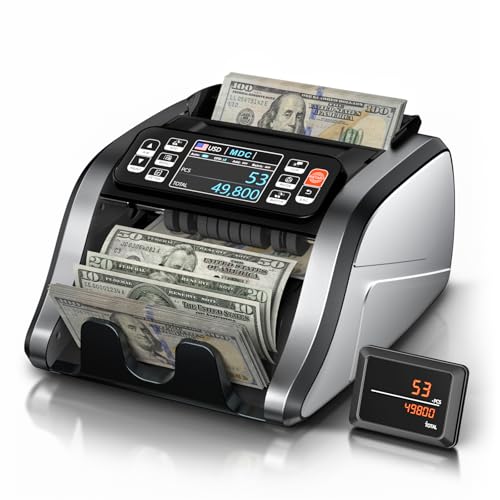
- Automatically counts mixed denominations and total value
- Supports five listed currencies and multiple counting modes
- 1,200+ bills per minute with multi-system detection
Best For: Retailers needing fast, flexible cash counting
Best Business-Grade Pick
Kolibri KBR-1500 V2 Mixed Counter

- Automatically sorts mixed USD bills and totals their value
- Includes six counting and batching modes
- Three-year warranty plus lifetime California-based support
Best For: Businesses processing mixed USD cash regularly
Best Budget-Friendly Option

- Counts up to 1,000 bills per minute
- Provides multiple counterfeit and error-detection systems
- Manual value setting supports Add and Batch workflows
Best For: Users comfortable setting denominations manually
Best Multi-Currency Pick
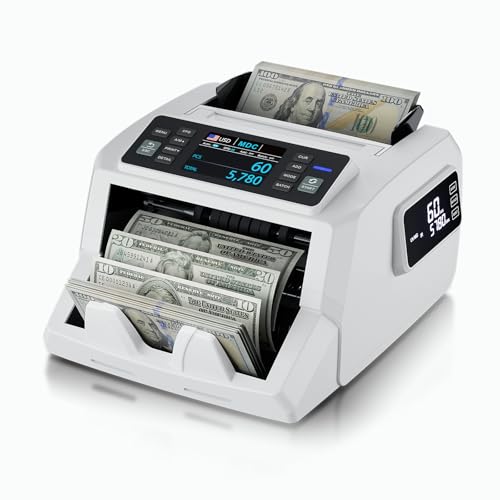
- Supports 120+ currencies
- Counts up to 1,200 bills per minute
- Includes five counterfeit-detection methods
Best For: Retail and multi-currency cash handling
Best for Tracking

- Uses dual CIS sensors
- Records bill serial numbers
- Offers 11 counterfeit-detection methods
Best For: Detailed cash tracking and reporting
Best Display Setup
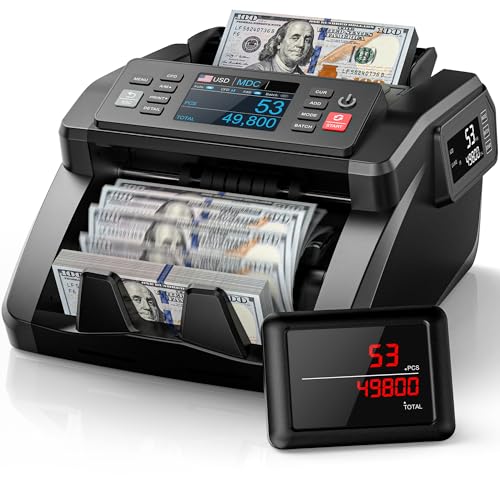
- Provides three viewing screens
- Counts up to 1,200 bills per minute
- Includes UV, MG, IR, and dimensional detection
Best For: Customer-facing counters needing visible totals
Best Overall Value – VEVOR Mixed Denomination Counter
For businesses comparing mixed denomination cash counting machines, the VEVOR WR-960 stands out for combining mixed-bill recognition, multi-currency support, and a high 1,200-notes-per-minute speed. Its CIS sensors read both sides of bills, while multiple detection systems help flag suspicious notes during counting.
Best For: Busy businesses that need fast mixed counting for USD, CAD, MXN, EUR, or GBP.
Pros:
- Recognizes mixed denominations and displays total quantity and value.
- Supports five currencies without pre-sorting.
- Includes UV, MG, IR, double, half, and chained-bill detection.
- 200-bill hopper and stacker capacities reduce interruptions.
Cons:
- Its 10.8-pound body may be less convenient for frequent relocation.
- The supplied notes do not specify software upgrade options beyond the listed currencies.
The dual-screen layout is useful where customers or staff need shared visibility. Overall, the VEVOR is a practical choice for high-volume cash reconciliation when speed and broad currency support matter.
Best for Shared Visibility – MUNBYN IMC22 Pro
The MUNBYN IMC22 Pro is a compact option among mixed denomination cash counting machines, with automatic value counting, a customer-facing display, and several operating modes. It supports USD, CAD, MXN, and COP, with upgrade assistance available for more currencies.
Best For: Retail counters, financial institutions, and offices where staff and customers should see the count.
Pros:
- Mixed Denomination Counting mode shows total value and bill quantity.
- Offers MDC, SDC, count, batch, and add modes.
- Uses CIS, UV, IR, MG, and MT sensors with 11 detection technologies.
- Compact design includes a 3.5-inch primary display and secondary display.
Cons:
- The recommended loading limit is 150 bills at a time.
- Correct bill placement is important for reducing jams.
- The supplied listing names four supported currencies before upgrades.
Its anti-static bill path and 1,200-bills-per-minute rating support efficient daily use, while the dual-display design improves transaction transparency. Buyers should follow the loading guidance closely for smoother operation.
Best for Cash Tracking – Aneken AL-931
The Aneken AL-931 adds cash-management features that distinguish it from many mixed denomination cash counting machines. It can recognize mixed denominations, record bill serial numbers, and operate at three selectable speeds, while its 4.5-inch touchscreen keeps controls and results accessible.
Best For: Businesses that want mixed counting with serial-number records and potential printed reports.
Pros:
- Supports mixed denomination counting and serial-number recognition.
- Selectable speeds of 800, 1,000, or 1,200 notes per minute.
- 2CIS technology works with UV, MG, IR, MT, and serial-number detection.
- Compatible with the optional Aneken P30 printer.
Cons:
- The printer is optional rather than included.
- Currency upgrades require contacting customer support.
- At 13.66 pounds, it is not the lightest model in this group.
The AL-931 is especially appealing when accountability matters as much as counting speed. Its serial-number capability and printer compatibility support more detailed records, while lifetime technical support and system upgrades add long-term flexibility.
Best Warranty Coverage – Kolibri KBR-500
The Kolibri KBR-500 is a business-grade choice for mixed denomination cash counting machines, combining 1,200-bills-per-minute processing with mix, sort, count, add, and batch modes. It supports USD, CAD, MXN, GBP, and EUR and includes a three-year warranty with lifetime technical support.
Best For: Businesses seeking broad counting modes, multi-currency support, and extended manufacturer coverage.
Pros:
- Automatically reads mixed bills and calculates total value.
- Supports mix, sort, count, add, and batch functions.
- Handles five listed currencies, including USD, CAD, MXN, GBP, and EUR.
- Includes infrared, ultraviolet, magnetic, half, chain, and double-bill detection.
Cons:
- Its 14.77-pound weight and larger dimensions require dedicated counter space.
- The supplied notes do not list a customer-facing secondary display.
The KBR-500 offers a versatile feature set for routine counts, sorting, deposits, and customized batches. Its larger footprint may matter in compact work areas, but the three-year warranty and lifetime support strengthen its long-term value.
Best Overall – Aneken N60 Mixed-Denomination Counter
For businesses comparing mixed denomination cash counting machines, the Aneken N60 stands out for combining automatic value counting, multiple counting modes, and broad currency support. It counts more than 1,200 bills per minute while adding several counterfeit-detection systems for higher-volume cash handling.
Best For: Retailers and other businesses that need fast mixed-currency counting with dual-screen viewing.
Pros:
- Automatically identifies bill values in mixed-denomination mode and calculates total value.
- Supports USD, CAD, MXN, EUR, and GBP, along with single-denomination, batch, accumulation, and number-counting modes.
- Uses infrared, ultraviolet, magnetic, and dimensional detection, with red-screen and audible alerts.
- Handles over 1,200 bills per minute and holds up to 200 bills in the hopper.
Cons:
- The 11.4-pound machine may be less convenient to move frequently.
- Its extensive features may be more than occasional cash counters need.
The N60 is a strong all-around choice when speed, automatic denomination recognition, and currency flexibility matter. Lifetime software updates and extended support add value for ongoing business use.
Best Business-Grade Pick – Kolibri KBR-1500 V2 Mixed Counter
The Kolibri KBR-1500 V2 is a business-grade option among mixed denomination cash counting machines, automatically reading mixed U.S. bill stacks, sorting by denomination, and reporting total value. Its range of operating modes and included three-year warranty make it suitable for organizations that want structured cash-processing support.
Best For: Retail stores, event venues, and offices handling mixed U.S. currency regularly.
Pros:
- Counts mixed USD bills, sorts by denomination, and provides total value counted.
- Offers MIX, SORT, COUNT, ADD, BATCH, and ADD+BATCH modes for different workflows.
- Runs at up to 1,200 notes per minute with UV, MG, and IR counterfeit detection.
- Includes lifetime California-based technical support and a three-year manufacturer warranty.
Cons:
- The supplied notes specify mixed-denomination operation for USD rather than multiple currencies.
- At 16.22 pounds, it is the heaviest model in this comparison.
Choose the KBR-1500 V2 if dependable business support and several cash-handling modes are priorities. It offers a practical balance of speed, automatic value calculation, and warranty coverage for recurring use.
Best Budget-Friendly Option – Aneken AL-1000 Value Counter
The Aneken AL-1000 is worth considering when you want the functions of mixed denomination cash counting machines but do not need automatic denomination recognition. It can count bills at up to 1,000 per minute, detect several bill issues, and calculate values when denominations are manually selected.
Best For: Users who can manually set denominations and need basic counting, adding, and batching functions.
Pros:
- Supports count, add, batch, and manual or automatic counting modes.
- Uses UV, MG, IR, dimensional, double-note, half-note, and chain detection.
- Counts up to 1,000 bills per minute with noise below 60 decibels.
- Includes an external display, currency straps, and lifetime technical support.
Cons:
- Does not automatically recognize bill denominations; users must set the value manually.
- Operates on 110V only.
- Its value calculation depends on using manual denomination settings with Add mode.
The AL-1000 is a sensible fit for straightforward cash-counting routines where manual denomination selection is acceptable. Buyers needing automatic mixed-bill value recognition should choose one of the other two models instead.
Best Multi-Currency Pick – LOLARAN N71
For businesses comparing mixed denomination cash counting machines, the LOLARAN N71 combines automatic bill-value recognition with broad currency support and multiple counting modes. It counts up to 1,200 bills per minute and includes CIS, UV, MG, IR, and DD counterfeit detection.
Best For: Retail counters, offices, and small businesses handling multiple currencies and customer-facing transactions.
Pros:
- Supports more than 120 currencies, including USD, CAD, MXN, EUR, and GBP.
- Uses five detection technologies to flag counterfeit, damaged, or suspicious bills.
- Dual-display setup includes a 3.5-inch TFT screen and external customer display.
- Includes 3-year protection, technical support, and free software upgrades.
Cons:
- Its 12.25-pound weight and relatively large footprint may require dedicated counter space.
- The supplied notes do not specify a serial-number tracking feature.
The N71 is a versatile choice when currency flexibility, visible results, and long-term support matter. Its broad currency compatibility makes it especially practical for businesses serving international customers.
Best for Tracking – MUNBYN IMC01
The MUNBYN IMC01 stands out among mixed denomination cash counting machines with dual CIS sensors that read both sides of each bill. It reports total value, denomination breakdowns, and serial numbers while supporting several currencies and printer-compatible output.
Best For: Small businesses, gas stations, churches, and banks that need detailed cash records and counterfeit screening.
Pros:
- Dual CIS technology reads both sides of bills and is designed for worn or damaged notes.
- Recognizes and records serial numbers for money tracking.
- Offers 11 counterfeit-detection methods, including 2CIS, UV, MG, IR, MT, and SN recognition.
- Supports mixed denomination, sorting, ADD, batch, and printer-compatible reporting functions.
Cons:
- Printing requires a compatible MUNBYN printer.
- Its 2-year protection period is shorter than the 3-year coverage listed for the LOLARAN N71.
Choose the IMC01 when auditability is as important as counting speed. Serial-number recognition and dual-sided scanning give it a strong fit for organizations that want more detailed cash-control records.
Best Display Setup – PONNOR N70
The PONNOR N70 is a practical option among mixed denomination cash counting machines for users who want clear results from several viewing angles. It automatically calculates denomination values in mixed-denomination mode, counts up to 1,200 bills per minute, and includes three displays.
Best For: Customer-facing counters and businesses that want visible totals for operators and customers.
Pros:
- Three-screen design shows bill quantity and value from multiple angles.
- Supports mixed denomination, single denomination, batch, add, and count modes.
- Uses UV, magnetic, infrared, and dimensional detection with alarms for suspicious bills.
- Includes voice settings in mixed- and single-denomination modes.
Cons:
- Currency support is limited to USD, MXN, CAD, EUR, and GBP.
- The listing notes that the machine does not count mixed bills in its stated currency configuration.
- The 110V American-standard plug is intended for use in the United States.
The N70 makes sense for U.S.-based businesses prioritizing display visibility and straightforward counterfeit alerts. Its three-screen layout is particularly useful where customers or multiple staff members need to see the count.
How We Picked the Best Mixed Denomination Cash Counting Machines
We focused on machines that count mixed bills by total value rather than simply tallying the number of notes. Each model was assessed for counting speed, denomination-recognition accuracy, counterfeit-detection features, display usability, hopper and stacker capacity, operating modes, and support for common currencies.
We also considered practical business features such as add and batch functions, dual or triple displays, serial-number reading, CIS imaging, and the ability to handle worn or unevenly stacked notes. Because requirements vary widely, the list includes both straightforward value counters and advanced machines designed for higher-volume cash operations.
Quick Comparison
- Best for general value counting: Choose a model with mixed-denomination recognition, UV/MG/IR detection, and a clear total-value display.
- Best for high-volume work: Prioritize a 1,200-notes-per-minute rating, reliable feeding, large hopper capacity, and easy batch controls.
- Best for enhanced verification: Look for CIS or 2CIS scanning, serial-number reading, and broader counterfeit-detection coverage.
- Best for shared counters: Dual- or triple-display designs make totals visible to both the operator and customer.
- Best for international use: Confirm supported currencies before buying; multi-currency capability is not universal.
Key Buying Factors for Mixed Denomination Cash Counting Machines
Counting Speed and Capacity
Speed matters in banks, cash offices, casinos, and busy retail environments, but the advertised maximum is not the only consideration. A machine should also feed bills consistently without frequent jams. Check hopper and stacker capacities if staff will process large batches throughout the day.
Counterfeit Detection
UV, magnetic, infrared, double-note, half-note, chain-note, and width or length checks each identify different problems. More detection modes can improve screening, but staff still need to inspect alerts and follow local cash-handling procedures. CIS-equipped machines may provide more detailed note imaging than basic sensor combinations.
Recognition and Currency Compatibility
Verify that the machine supports the denominations and currency you actually handle. Some models are optimized for U.S. dollars, while others support multiple currencies. Mixed counting also works best when bills are reasonably aligned and in acceptable condition.
Controls, Displays, and Reporting
A bright LCD or TFT screen, intuitive controls, and visible totals reduce training time. Add and batch modes are useful for preparing deposits, while serial-number functions can support traceability where required. Dual displays are helpful when customers need to see the counted amount.
Maintenance and Workflow
Choose a model with accessible sensors, straightforward cleaning instructions, and replacement parts or technical support that are easy to obtain. Regular dust removal and careful note alignment help preserve accuracy and reduce feeding problems.
Who Should Buy Which Mixed Denomination Cash Counting Machines?
Small retailers and offices should choose a simple, easy-to-use mixed-value counter with dependable UV/MG/IR detection and a readable display. Busy stores and cash-intensive businesses should prioritize high speed, batch and add modes, strong feeding performance, and a large hopper.
Banks, currency exchanges, and professional cash rooms may benefit from CIS scanning, serial-number recognition, multi-currency support, and expanded counterfeit detection. Businesses serving customers at the counter should consider dual- or triple-display models so totals are easy to verify. Before ordering, confirm voltage, currency support, warranty terms, and the seller’s return policy.