Choosing a mixed denomination bill counter for bank use means balancing speed, accuracy, fraud detection, and day-to-day workflow. The right machine can reduce manual counting time while improving cash control.
This roundup focuses on bank-grade options built for value counting, counterfeit detection, and multi-currency environments, so you can match the machine to your teller line, back office, or cash room.
Best 10 Mixed Denomination Bill Counter for Bank Use Picks for 2026
Premium Bank-Grade Mixed Counter

- Mixed denomination and mixed-currency value counting
- Serial number recognition plus UV/IR/MG/2CIS detection
- 4.3" touchscreen, external display, and printer support
Best For: North American businesses needing bank-grade mixed counting and support
Triple-Display Value Counter
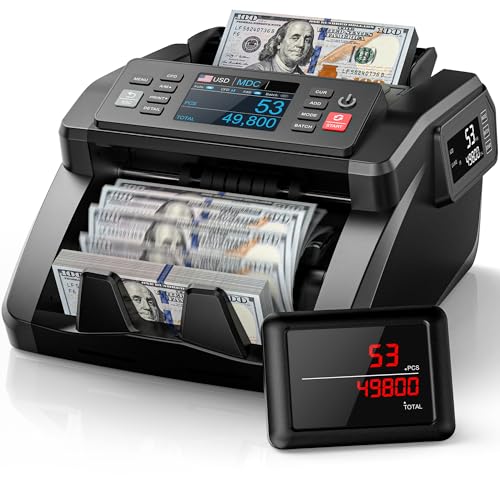
- Automatic denomination recognition in MDC mode
- Triple-screen layout with external display
- UV/MG/IR plus dimensional counterfeit detection
Best For: U.S. businesses needing value counting with clear multi-angle viewing
Serial-Tracking Bank Counter

- Mixed denomination counting across 20 currencies
- Serial numbers can be recorded, printed, or exported
- Dual CIS imaging with UV/MG/MT/IR detection
Best For: Banks and FX businesses needing traceable mixed-currency counting
High-Speed Mixed Counter

- CIS-based mixed denomination recognition
- Supports USD, CAD, MXN, EUR, and GBP
- UV/MG/IR plus double, half, and chain detection
Best For: Busy cash counters needing fast mixed-value processing
Bank-Grade Value Counter
MUNBYN IMC01 Mixed Denomination Counter
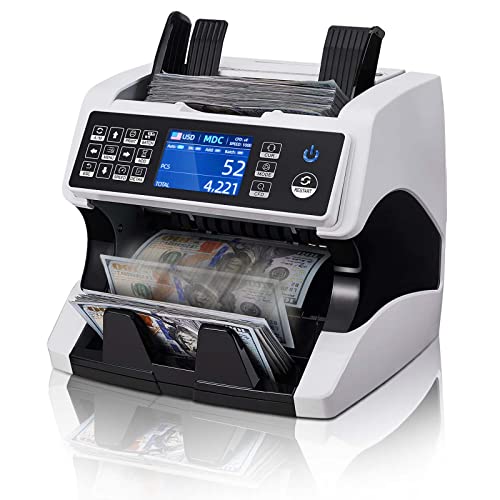
- 2CIS scans both sides of each bill
- Counts value, quantity, and serial numbers
- Supports multiple currencies and printer output
Best For: Banks and cash businesses needing detailed mixed-bill counting
Compact Value Counting Pick
RIBAO BC-40 Mixed Denomination Counter
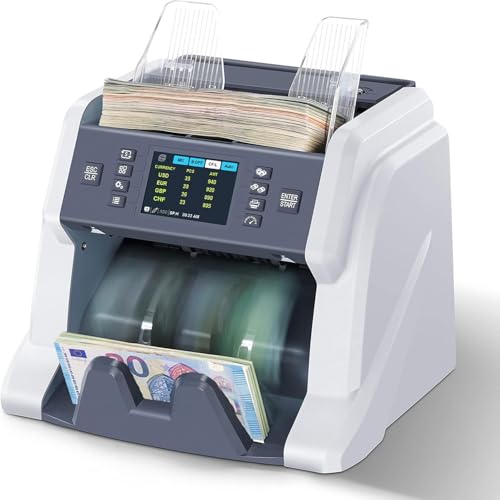
- Mixed, single, batch, and accumulation modes
- CIS, UV, MG, and IR counterfeit detection
- Compact body with rear-access cleaning
Best For: Users who want a compact mixed-bill counter with simple maintenance
Fast Mixed-Stack Counter
BillMaster B70 Mixed Denomination Counter

- No pre-sorting needed for U.S. bills
- Up to 1,300 bills per minute
- CIS plus UV, MG, IR, and DD detection
Best For: Fast U.S. cash-counting teams that want value counting and printer support
Value-Focused Mixed Denomination Counter
Aneken N60 Mixed Denomination Counter

- Auto-recognizes bill values in MDC mode
- UV, MG, IR, and dimensional counterfeit detection
- 3.5" TFT plus external display
Best For: Small businesses and cash offices needing value counting with multi-currency support
Dual-Display Security Pick
LOLARAN N71 Mixed Denomination Counter
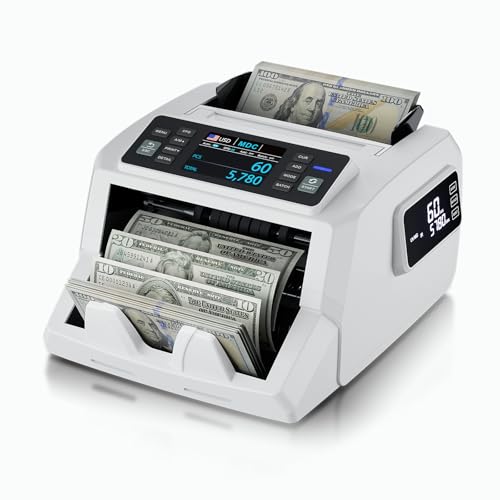
- CIS, UV, MG, IR, and DD counterfeit detection
- Real-time value and quantity display in mixed mode
- Dual-screen setup with external customer display
Best For: Retail and business counters that want stronger counterfeit screening
Bank-Grade Feature Leader
DETECK DT600 Mixed Denomination Counter

- 2CIS, UV, MG, IR, MT, and serial number recognition
- Shows grand total and value by denomination
- Printer-enabled and built for mixed currencies
Best For: Cash handlers who want detailed reporting and advanced security
Premium Bank-Grade Mixed Counter – Cassida 8800R V2 USA
If you need a mixed denomination bill counter for bank use, the Cassida 8800R V2 is built for value counting, denomination sorting, and multi-currency work in one machine. It uses advanced multi-sensor counterfeit detection and supports MIX, SORT, VSORT, COUNT, FACE, ORIENT, ADD, and BATCH modes for flexible cash handling.
Best For: Small to medium businesses, casinos, gas stations, and convenience stores that want a USA-supported bank-grade counter.
Pros:
- Counts both value and number of bills, including mixed denominations and mixed currencies
- Advanced detection with serial number recognition, UV, IR, MG, and 2CIS sensors
- 4.3″ touchscreen display, external display, and printing support
- USA-engineered, inspected, shipped, and supported with a 3-year warranty
Cons:
- May be more machine than a basic single-denomination counter
- Designed for North American businesses, so its fit may be less ideal for simple cash-only needs
The 8800R V2 stands out as a feature-rich option when accuracy, sorting, and support matter more than keeping things basic. It is a strong pick for teams that process varied cash and want bank-grade tools without giving up usability.
Triple-Display Value Counter – PONNOR N70
The PONNOR N70 is a practical mixed denomination bill counter for bank use when you need value counting, batch work, and counterfeit checks in one unit. In MDC mode it recognizes denominations automatically, while the triple-display layout makes it easier to read counts and values from multiple angles.
Best For: Businesses that want a value-counting cash counter with triple displays and printer support, but only for U.S.-standard use.
Pros:
- MDC, SDC, CNT, Batch, and Add modes for flexible cash handling
- UV, MG, IR, and dimensional detection for counterfeit protection
- Three-screen design plus external display for easier viewing
- Counts up to 200 bills at 1,200 pcs/min for faster processing
Cons:
- Supports mixed denomination counting, but not mixed bills in the same run
- U.S.-only 110V plug limits international use
For buyers who want a fast, straightforward value counter with strong detection and a clear display setup, the N70 is an appealing option. Its limitation on mixed bills is important, but within its intended use case it offers a solid feature set.
Serial-Tracking Bank Counter – RIBAO BC-55
If you’re comparing a mixed denomination bill counter for bank use, the RIBAO BC-55 is built around value counting, multi-currency handling, and serial number recording. It also uses dual CIS imaging along with UV, MG, MT, and IR detection to deliver a more advanced inspection workflow.
Best For: Banks, foreign exchange offices, and cash-heavy businesses that need mixed denomination counting with serial tracking.
Pros:
- Counts mixed denominations and supports 20 currencies
- Serial numbers can be recorded, printed, or sent to a computer
- Dual CIS imaging for two-sided bill inspection
- Touchscreen interface with multiple working modes, including SDC, CNT, ADD, and BATCH
Cons:
- Feature set may be more advanced than needed for simple daily cash counting
- Heavier, bank-grade design may be less compact for small counters
The BC-55 is a strong choice when traceability matters as much as speed and value counting. Its serial recording and imaging-based detection make it especially suited to operations that want more control over cash processing.
High-Speed Mixed Counter – VEVOR 1200 Notes/Minute
The VEVOR mixed denomination bill counter for bank use focuses on fast value counting, automatic denomination recognition, and broad counterfeit detection. With CIS sensors scanning both sides of each bill, it can handle mixed cash without pre-sorting while showing totals on a dual-display setup.
Best For: Busy businesses that want fast mixed counting with straightforward multi-currency support.
Pros:
- Automatically recognizes denominations for mixed counting
- Supports USD, CAD, MXN, EUR, and GBP
- UV, MG, IR, DD, DBL, HLF, and CHN detection for suspicious notes
- 3.5″ TFT display plus external display for shared viewing
Cons:
- Multi-currency support is limited to the listed currencies
- Hopper and stacker capacities are sized for 200 bills, so very large batches still require refill cycles
VEVOR’s machine is a practical fit if your priority is speed with minimal sorting. It brings together mixed counting, detection, and dual displays in a format aimed at day-to-day cash handling.
Bank-Grade Value Counter – MUNBYN IMC01 Mixed Denomination Counter
If you need a mixed denomination bill counter for bank use that can also handle retail or cash-heavy back-office work, the MUNBYN IMC01 is built around value counting, serial number tracking, and multi-currency support. Its 2CIS design scans both sides of each bill, helping it handle worn or slightly damaged notes more accurately than basic single-sensor models.
Best For: Banks, small businesses, and cash-handling teams that want value counting with strong counterfeit detection and serial number tracking.
Pros:
- Counts mixed denominations and reports total value with a clear breakdown by denomination and quantity.
- 2CIS dual-sided scanning is designed to improve accuracy on worn, ripped, or damaged bills.
- Supports multiple currencies and printer output, with ADD, BATCH, and Auto/Manual counting modes.
- Includes 11 counterfeit detection methods, plus serial number recognition and record keeping.
Cons:
- Printer output requires a compatible MUNBYN printer.
- Feature-rich operation may be more than simple piece-counting users need.
The IMC01 is a strong fit when accuracy, reporting detail, and fraud checks matter more than a basic count. For teams that process mixed cash stacks regularly, its bank-grade feature set is the main draw.
Compact Value Counting Pick – RIBAO BC-40 Mixed Denomination Counter
The RIBAO BC-40 is a practical mixed denomination bill counter for bank use when you want value counting in a compact format. It handles mixed denomination counting, multi-currency mixed counting, and everyday piece or batch tasks, while its CIS, UV, MG, and IR detection helps support routine counterfeit screening.
Best For: Businesses that want a compact value counter with straightforward mixed-denomination handling and easy maintenance.
Pros:
- Offers MIX, single denomination, auto recognition, multi-currency mixed counting, piece counting, batch, and accumulation modes.
- Supports value counting and counterfeit detection for USD, euro, Canadian dollar, and Mexican peso.
- Front-facing 3.5-inch TFT touch screen keeps operation simple.
- Rear access makes sensor cleaning and jam removal easier, and a dust cover is included.
Cons:
- Supported value-counting currencies are limited to USD, euro, Canadian dollar, and Mexican peso.
- Smaller footprint may suit lighter-duty setups more than very high-volume stations.
BC-40 stands out for users who want mixed denomination counting without a bulky machine. It balances useful detection features with easy upkeep and a compact layout.
Fast Mixed-Stack Counter – BillMaster B70 Mixed Denomination Counter
The BillMaster B70 is a mixed denomination bill counter for bank use that emphasizes speed, automatic denomination recognition, and everyday cash management. It counts mixed $1, $5, $10, $20, $50, and $100 bills in one stack, while its CIS sensor and UV, MG, IR, and DD detection are designed to help flag suspicious bills during counting.
Best For: Businesses that want fast mixed-denomination counting with printer compatibility and strong day-to-day usability.
Pros:
- Counts mixed U.S. bills without pre-sorting and calculates total value automatically.
- Claims up to 1,300 bills per minute for fast cash handling.
- Includes CIS image sensing plus UV, MG, IR, and DD counterfeit detection.
- Supports value count, batch count, add mode, auto/manual start, and printer compatibility.
Cons:
- The notes focus on U.S. denominations, so it may not be the best fit for multi-currency operations.
- Its advanced feature set may be more than needed for low-volume counters.
For businesses that want speed and straightforward mixed-stack counting, the B70 is positioned as a capable option. Its clear TFT display and heavy-duty build add to its appeal in busier cash rooms.
Value-Focused Mixed Denomination Counter – Aneken N60 Mixed Denomination Counter
If you need a mixed denomination bill counter for bank use or other high-cash workflows, the Aneken N60 is built around speed, value counting, and basic bank-grade verification. In MDC mode it recognizes bill values automatically, while the dual-screen setup helps both operators and customers follow the count at a glance.
Best For: Small businesses, retail counters, and cash offices that want mixed denomination counting with clear value display and multi-currency support.
Pros:
- Mixed denomination counting shows quantity and amount at the same time.
- Supports USD, CAD, MXN, EUR, and GBP.
- Bank-grade counterfeit detection includes UV, MG, IR, and dimensional checks.
- Counts more than 1,200 bills per minute with a 200-bill hopper.
Cons:
- Best results depend on following the correct money placement method.
- Noisy or jam-prone use can be reduced, but the manual/video guidance still matters.
The N60 focuses on practical value counting and broad currency support rather than advanced specialty features. For buyers who want a straightforward mixed denomination bill counter for bank use, it offers a solid mix of speed, detection, and visibility.
Dual-Display Security Pick – LOLARAN N71 Mixed Denomination Counter
The LOLARAN N71 is a mixed denomination bill counter for bank use that emphasizes detection depth, multi-currency handling, and easy visibility at the counter. It automatically recognizes bill values, shows quantity and total in real time, and uses a dual-display layout that works well in customer-facing environments.
Best For: Retail, offices, casinos, and business counters that need mixed denomination counting with stronger counterfeit screening.
Pros:
- CIS, IR, UV, MG, and DD detection for counterfeit, damaged, and suspicious bills.
- Supports mixed denomination, single denomination, batch, accumulation, and count modes.
- Compatible with 120+ currencies including USD, CAD, MXN, EUR, and GBP.
- 3.5″ TFT main display plus secondary external customer screen.
Cons:
- Heavier than some compact units at 12.25 pounds.
- Its feature set is more than basic users may need.
Overall, the N71 is a strong fit if you want a mixed denomination machine that balances speed, visibility, and layered counterfeit detection. The included 3-year protection also adds confidence for regular cash-handling use.
Bank-Grade Feature Leader – DETECK DT600 Mixed Denomination Counter
The DETECK DT600 is a mixed denomination bill counter for bank use aimed at buyers who want deeper reporting and security features. It counts mixed currency batches, shows totals by denomination on screen, and can connect to a printer for added convenience.
Best For: Businesses and cash handlers that want detailed denomination reporting, serial-number recognition, and advanced counterfeit detection.
Pros:
- Advanced detection with 2CIS, UV, MG, IR, MT, and serial number recognition.
- Displays grand total, bill quantity, and value by denomination.
- Handles mixed currencies including USD, CAD, MXN, EUR, and GBP.
- Designed to sort bills by denomination, face, and orientation.
Cons:
- Printer is sold separately.
- Feature depth may be unnecessary for simpler cash-counting tasks.
For users who value reporting detail and security, the DT600 stands out as the most feature-rich option here. Its bank-grade detection and denomination-level output make it especially appealing for organized cash operations.
How We Picked the Best Mixed Denomination Bill Counter for Bank Use
We focused on machines built for professional cash handling rather than basic note counters. Key considerations included mixed-denomination value counting, sensor quality, counterfeit detection depth, multi-currency support, serial-number reading where available, display clarity, and whether the unit is suitable for heavy daily use in a bank or credit union.
Quick Comparison
If you want the simplest path, narrow your choices by workflow: entry-level mixed denomination counters are best for moderate cash volume, while bank-grade CIS models are better for fast, high-trust operations that need fewer manual checks. Models with dual CIS sensors, stronger authentication suites, and clearer dual displays generally cost more but offer better verification and fewer sorting steps.
Key Buying Factors for Mixed Denomination Bill Counter for Bank Use
Detection Stack
For bank use, counterfeit detection should go beyond UV alone. Look for combinations such as CIS, UV, MG, IR, MT, DD, and half-note detection. More sensors do not automatically mean better performance, but they usually improve confidence when handling mixed batches and worn notes.
Mixed Denomination Accuracy
The main advantage of a Mixed Denomination Bill Counter for Bank Use is value counting without pre-sorting. Check whether the machine supports true mixed value counting or only mixed batching with denomination recognition. Also verify compatibility with the currencies you handle most.
Throughput and Workflow
Speed matters, but only if it holds up in real conditions. Consider hopper capacity, count speed, reject handling, and whether the display clearly shows totals, denomination breakdowns, and errors. Teller stations often benefit from compact units, while cash rooms may prefer higher-capacity machines with stronger automation.
Displays and Usability
Dual displays, large touchscreens, and clear operator prompts help reduce mistakes and training time. If multiple staff members will use the machine, easy menus and visible alerts are especially useful.
Service and Durability
Bank environments demand reliable parts support, firmware stability, and consistent performance with varied note conditions. Warranty length and vendor reputation matter more here than they do for light retail use.
Who Should Buy Which Mixed Denomination Bill Counter for Bank Use?
Front-line teller teams should prioritize simple controls, fast value counting, and readable displays. Back-office cash handlers should look for stronger counterfeit detection and higher throughput. Multi-currency operations need broad denomination recognition and currency flexibility. If your workflow includes frequent suspect notes or mixed deposits, spend more for a bank-grade CIS model rather than a basic value counter.