If your business handles a lot of cash, the right bill counter can save hours and reduce mistakes. Mixed denomination models go beyond simple note counting, helping you total stacks faster without pre-sorting.
Below, we focus on machines that combine value counting, batch controls, and counterfeit detection so you can choose a practical fit for retail, hospitality, offices, and cash-heavy operations.
Best 10 Mixed Denomination Bill Counter with Batch Function Picks for 2026
Triple-Display Value Counter
PONNOR N70 Mixed Denomination Money Counter
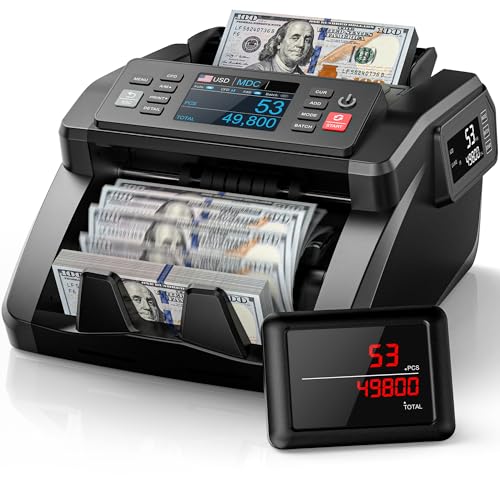
- MDC, SDC, CNT, batch, and add modes
- Triple displays with 3.5-inch TFT LCD
- UV, MG, IR, and dimensional detection
Best For: Businesses that want value counting with strong visibility and counterfeit checks
Batch-Friendly Value Counter

- Add mode and batch stop for organized counting
- Manual value setting for total bill value
- UV, MG, IR, DD, DBL, HLF, and CHN detection
Best For: Users who want batch counting with manual value entry
No-Pre-Sort Cash Counter

- Counts supported mixed U.S. bills without pre-sorting
- Batch Count, Add Mode, and Value Count included
- CIS sensor plus UV, MG, IR, and DD detection
Best For: Businesses that want mixed bill counting without pre-sorting
Quiet Multi-Mode Counter

- COUNT, ADD, BATCH, AUTO, and MANUAL modes
- Value count for selected denominations in add mode
- UV, MG, IR, MT, and DD detection plus silent mode
Best For: Businesses that want flexible batch counting with quieter operation
Business-Grade Value Counter
KOLIBRI KBR-500 Mixed Denomination Counter

- Counts mixed bills and total value
- MIX, SORT, COUNT, ADD, BATCH modes
- USD, CAD, MXN, GBP, EUR support
Best For: Businesses needing reliable value counting with strong counterfeit checks
Quiet High-Speed Counter
Eizeny Mixed Denomination Bill Counter

- Auto-detects USD, CAD, MXN, EUR, GBP
- Counts up to 1,250 bills per minute
- Under-50dB operation with touch screen
Best For: Retail and market counters that need fast, quiet cash handling
Compact Heavy-Duty Counter
NUCOUN VC-1 Mixed Bill Counter
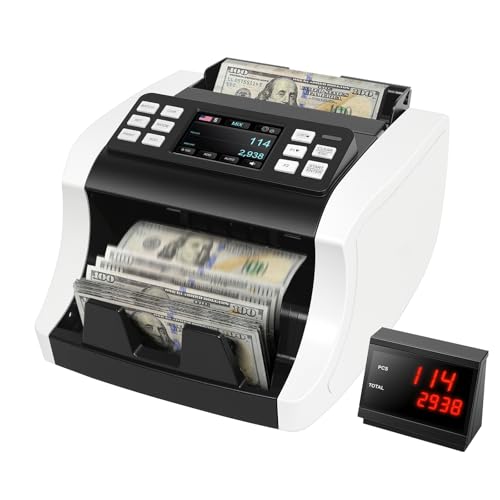
- Mixed-denomination value counting
- CIS, UV, MG, IR detection
- Supports 120+ currencies
Best For: Small businesses needing a compact, feature-rich bill value counter
Mixed-Value Speed
VEVOR 1200 Notes/Minute Mixed Denomination Counter

- Scans both sides of bills with CIS sensors
- Counts mixed denominations and total value
- Supports USD, CAD, MXN, EUR, and GBP
Best For: Businesses needing fast mixed-bill counting with multi-currency support
Bank-Grade Checks
MUNBYN IMC22 Mixed Denomination Counter

- MDC mode counts mixed bills by value and quantity
- Uses CIS, UV, MG, IR, and MT security checks
- Dual-screen design improves transaction visibility
Best For: Banks, casinos, and busy merchants needing detailed counterfeit screening
Flexible Counting Modes
Aneken N60 Mixed Denomination Bill Counter
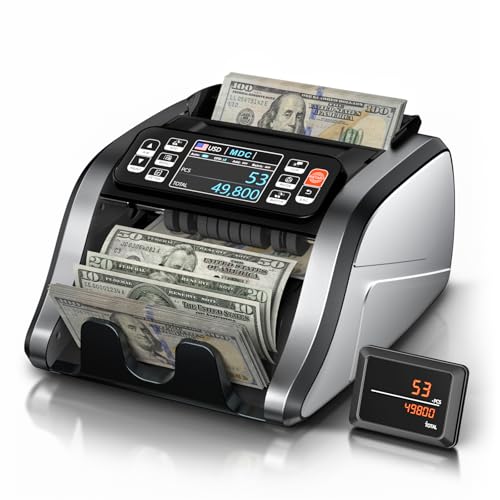
- Includes MDC, batch, accumulation, and single modes
- Enhanced software helps reduce false alarms and jams
- Supports USD, CAD, MXN, EUR, and GBP
Best For: Businesses wanting flexible mixed counting with batch and accumulation modes
Triple-Display Value Counter – PONNOR N70 Mixed Denomination Money Counter
If you need a mixed denomination bill counter with batch function for multi-currency cash handling, the PONNOR N70 is built for value counting, batch mode, and add mode in a compact business-ready format. It supports mixed denomination counting for USD, MXN, CAD, EUR, and GBP in MDC mode, while also offering single-denomination counting and counterfeit detection to help streamline daily cash work.
Best For: Businesses that want value counting, triple-display visibility, and counterfeit detection for supported currencies.
Pros:
- Mixed denomination counting, plus SDC, CNT, batch, and add modes
- Triple-display setup with 3.5-inch TFT LCD, side screens, and external display
- UV, MG, IR, and dimensional counterfeit detection with alarm alerts
- Counts up to 1,200 bills per minute and includes voice setting options
Cons:
- Mixed bills are not supported in mixed denomination mode
- 110V American standard plug limits use to the United States unless converted
- Can count up to 200 pieces at a time, so very large stacks still need loading in groups
The N70 is a strong fit if your priority is quick value counting with clear readouts and solid counterfeit screening. Its multi-display design and support for common currencies make it practical for busy counters that want speed and visibility.
Batch-Friendly Value Counter – Aneken AL-1000 Money Counter
The Aneken AL-1000 is a practical mixed denomination bill counter with batch function features like add and batch modes, but it relies on manual value setting rather than automatic denomination recognition. That makes it a sensible option if you want dependable counting, counterfeit alerts, and value tallying for organized cash handling.
Best For: Users who want a durable counter with batch mode and manual value counting.
Pros:
- Add mode lets multiple counting batches build into one total
- Batch mode stops at a preset bill count for organized processing
- Manual value setting can calculate total bill value in add mode
- UV, MG, IR, DD, DBL, HLF, and CHN detection with alarm alerts
Cons:
- Does not automatically recognize bill denominations
- 110V only, so it is not intended for international voltage use without conversion
- Value counting depends on manually selecting the denomination first
This model makes sense when your workflow is based on counting in batches and entering denominations yourself. It is less automated than mixed-recognition machines, but it still covers the core tasks most small businesses need.
No-Pre-Sort Cash Counter – BillMaster B70 Money Counter
If you are shopping for a mixed denomination bill counter with batch function capabilities, the BillMaster B70 is aimed at fast value counting without pre-sorting. It recognizes mixed $1, $5, $10, $20, $50, and $100 bills in one stack, then combines value count, batch count, and add mode for efficient daily cash handling.
Best For: Retailers and small businesses that want no-pre-sorting mixed bill counting with batch tools.
Pros:
- No pre-sorting required for supported U.S. bill denominations
- Value Count, Batch Count, and Add Mode for daily cash workflows
- CIS sensor with UV, MG, IR, and DD counterfeit detection
- TFT display shows denomination, bill count, and total value
Cons:
- Mixed counting is limited to the supported U.S. denominations listed
- Some setup and troubleshooting may still be needed despite U.S. support
- Heavy-duty build is beneficial, but it also makes the unit relatively substantial
The B70 stands out for removing the need to pre-sort supported bills, which can save meaningful time at closing. Its mix of mixed counting, batch tools, and counterfeit detection makes it a balanced choice for higher-volume businesses.
Quiet Multi-Mode Counter – PONNOR US0720-N Money Counter
The PONNOR US0720-N is a feature-rich mixed denomination bill counter with batch function support, combining COUNT, ADD, BATCH, AUTO, and MANUAL modes with value counting. It also includes UV, MG, IR, MT, and DD counterfeit detection, making it a versatile option for straightforward daily cash processing.
Best For: Businesses that want batch counting, value counting, and a quiet operating mode.
Pros:
- Supports COUNT, ADD, BATCH, AUTO, and MANUAL modes
- Value counting can total selected denominations in add mode
- UV, MG, IR, MT, and DD detection with error alerts
- Silent mode keeps noise below 60 dB for quieter use
Cons:
- Value counting does not total a mixed pile of banknotes automatically
- 110V U.S.-standard plug limits direct use outside the United States
- Bills must be loaded correctly to avoid error reports
This model is a practical fit if you want flexible modes and a quieter counting experience. It is strongest for users who can work within its denomination-selection approach and want a dependable daily counter with batch control.
Business-Grade Value Counter – KOLIBRI KBR-500 Mixed Denomination Counter
If you need a mixed denomination bill counter with batch function for a busy cash-handling workflow, the KOLIBRI KBR-500 is built to do more than simple tallying. It counts mixed stacks, calculates total value, and switches between MIX, SORT, COUNT, ADD, and BATCH modes so you can handle daily cash with less manual work.
Best For: Businesses that want a value-counting machine with counterfeit detection, multi-currency support, and long-term warranty coverage.
Pros:
- Counts mixed denominations and provides total value, not just bill quantity.
- Includes MIX, SORT, COUNT, ADD, and BATCH modes for flexible cash handling.
- Supports USD, CAD, MXN, GBP, and EUR.
- Uses IR, UV, MG, MT, DD, and HLF detection for counterfeit and error checks.
Cons:
- Heavier and larger than compact desktop counters.
- May be more machine than a very small business needs.
The KBR-500 stands out if you want a practical bill counter that can sort mixed cash and handle batch processing in one unit. Its business-grade feature set and 3-year warranty make it a strong choice for organizations that count cash regularly.
Quiet High-Speed Counter – Eizeny Mixed Denomination Bill Counter
This mixed denomination bill counter with batch function is aimed at stores and markets that need fast, low-stress cash counting. It recognizes major currencies automatically, calculates mixed-stack totals, and offers MIX, SDC, ADD, and BATCH modes from a 3.7-inch touch screen.
Best For: Retailers and other high-volume cash users who want quiet operation, fast counting, and modern touchscreen controls.
Pros:
- Counts mixed denominations and auto-detects USD, CAD, MXN, EUR, and GBP.
- Up to 1,250 bills per minute with under-50dB operation.
- 3.7-inch TFT touch screen with MIX, SDC, ADD, and BATCH modes.
- High-resolution CIS detection with 10+ counterfeit detection modes.
Cons:
- Compact format may not suit users who want a larger machine footprint.
- Feature-rich interface may be more than basic counting needs require.
The Eizeny model is a good fit when speed and noise level matter as much as accuracy. Its jam-resistant feeding, touch interface, and commercial-grade detection make it a well-rounded everyday cash counter.
Compact Heavy-Duty Counter – NUCOUN VC-1 Mixed Bill Counter
The NUCOUN VC-1 is a mixed denomination bill counter with batch function designed for small businesses that still need commercial-grade features. It calculates total value across mixed cash, supports automatic currency detection, and includes MIX, SDC, ADD, and BATCH modes for streamlined daily processing.
Best For: Small businesses, retail shops, and offices that want a compact bill value counter with advanced counterfeit protection.
Pros:
- Counts mixed denominations and supports auto-currency detection.
- Pre-programmed for USD, CAD, MXN, EUR, GBP, and JPY, with support for 120+ currencies.
- CIS, UV, MG, and IR detection helps verify bills more thoroughly.
- Compact heavy-duty design fits smaller workspaces.
Cons:
- 3-month exchange coverage is shorter than some competitors’ warranties.
- Listed item details may be less straightforward than premium models.
If you want a space-saving machine that still brings mixed-counting and advanced detection to the table, the VC-1 is a practical option. It balances versatility, speed, and broad currency support for everyday business use.
Mixed-Value Speed – VEVOR 1200 Notes/Minute Mixed Denomination Counter
If you need a mixed denomination bill counter with batch function for busy cash handling, this VEVOR model is built to total both bill count and value without pre-sorting. It uses CIS sensors to scan both sides of each note, supports multiple currencies, and adds counterfeit checks to help flag suspicious bills before they slow down reconciliation.
Best For: Businesses that want fast mixed-bill counting with currency support and strong counterfeit screening.
Pros:
- Counts mixed denominations and shows both total quantity and value
- Supports USD, CAD, MXN, EUR, and GBP without pre-sorting
- Counterfeit detection includes UV, MG, IR, DD, DBL, HLF, and CHN checks
- Handles peak hours with a 200-bill hopper and 1200 notes/minute speed
Cons:
- Hopper capacity is limited to 200 bills per load
- Designed more for counting and detection than compact portability
The VEVOR is a practical pick when you want mixed-bill value counting plus broad currency coverage in one machine. It is especially useful for end-of-day cash handling where speed and verification matter together.
Bank-Grade Checks – MUNBYN IMC22 Mixed Denomination Counter
The MUNBYN IMC22 is a mixed denomination bill counter with batch function and bank-style verification tools for businesses that need fast, transparent cash handling. In MDC mode, it identifies mixed bills by value and quantity, while CIS, UV, MG, IR, and MT sensors add layered counterfeit screening for more demanding environments.
Best For: Retailers, banks, casinos, and other high-volume cash businesses that want detailed bill verification.
Pros:
- Mixed denomination mode reports both bill count and total value
- 11 layers of security checks with CIS, UV, MG, IR, and MT sensors
- Counts up to 1,200 bills per minute with claimed 99.9% accuracy
- Dual-screen layout helps both operators and customers see results
Cons:
- Best performance depends on correct bill placement to avoid jams
- Feature set may be more than basic users need
Overall, the IMC22 is the strongest fit if your priority is verification depth as much as speed. Its multi-layer detection and customer-facing display make it a solid choice for busy counters where trust and clarity matter.
Flexible Counting Modes – Aneken N60 Mixed Denomination Bill Counter
The Aneken N60 is a mixed denomination bill counter with batch function options that make it easy to switch between value counting, single-denomination work, batch mode, and accumulation. It uses enhanced software and a redesigned internal structure to reduce false alarms and jamming, while its CIS-style mixed counting approach and counterfeit detection help keep daily cash work organized.
Best For: Businesses that want flexible modes and a cleaner mixed-count workflow with fewer interruptions.
Pros:
- Offers MDC, SDC, CNT, batch, and accumulation modes
- Supports USD, CAD, MXN, EUR, and GBP
- Enhanced software is designed to reduce false alarms and jams
- 3.5″ TFT display and external monitor make results easy to read
Cons:
- Mixed counting is only one of several modes, so setup may take a moment
- Hopper capacity is capped at 200 bills
The N60 stands out for buyers who want more than basic mixed counting and need batch-oriented flexibility too. It is a balanced choice for business users who value reliable detection, readable displays, and a smoother counting experience.
How We Picked the Best Mixed Denomination Bill Counter with Batch Function
We prioritized Mixed Denomination Bill Counter with Batch Function models that are useful in real-world cash handling, not just fast on paper. The main factors were mixed-note value counting accuracy, supported currencies, counterfeit detection methods, display clarity, and whether the machine could handle daily workloads without constant jams or manual sorting.
We also looked for business-friendly features like dual displays, add and batch modes, quieter operation, and sensor setups such as CIS, UV, MG, and IR. If a model was clearly built for commercial use, it ranked higher.
Quick Comparison
For smaller counters and offices, compact models with straightforward value counting and batch controls are usually enough. For higher-volume environments, choose a machine with CIS sensor-based mixed-denomination reading, stronger counterfeit detection, and a faster feed rate. If you process multiple currencies, confirm support before buying rather than assuming universal compatibility.
Key Buying Factors for a Mixed Denomination Bill Counter with Batch Function
Value Counting Vs. Simple Counting
Basic counters only tell you how many notes you have. A Mixed Denomination Bill Counter with Batch Function should also calculate total cash value, which is the main time-saver when denominations are mixed in one stack.
Batch Mode and Add Mode
Batch mode is helpful when you need counted stacks of a fixed size for deposits or tills. Add mode helps total multiple runs without resetting the machine. If you close registers or prepare bank deposits, both features are worth having.
Counterfeit Detection
Look for a combination of UV, MG, IR, and ideally CIS-based detection. No counterfeit system is perfect, but more layers of verification improve confidence, especially if you handle high-value cash or mixed currency notes.
Speed, Capacity, and Noise
Faster machines help during peak hours, but only if they remain accurate and jam-resistant. Low-noise operation matters in customer-facing environments, while a larger hopper and stable feed path help in busier back rooms.
Display and Workflow
A clear LCD or dual-display setup makes it easier for staff to verify totals quickly. If more than one person uses the machine, visible totals and simple controls reduce training time and mistakes.
Who Should Buy Which Mixed Denomination Bill Counter with Batch Function?
Small businesses with moderate cash volume should focus on ease of use, reliable batch counting, and solid counterfeit detection. Retailers and restaurants with heavier daily cash flow should lean toward CIS-equipped models with stronger jam resistance and better mixed-denomination accuracy. Multi-currency businesses should narrow the shortlist to models that explicitly support the currencies they handle, rather than paying extra for features they will not use.
In short, choose the machine that matches your counting volume, currency mix, and need for batch control. That is the fastest path to better cash handling and fewer end-of-day surprises.