Accurate color starts with reliable measurement. The best colorimeter color calibration tools help photographers, video editors, designers, retailers, and DIY users reduce guesswork across screens, cameras, and physical surfaces.
This roundup covers monitor calibrators, camera-focused kits, and portable paint color scanners, with options ranging from straightforward plug-and-play devices to advanced tools for bright HDR displays.
Best 10 Colorimeter Color Calibration Tools Picks for 2026
Portable Paint-Matching Pick

- Scans colors and suggests paint matches
- Provides CIELAB, RGB, and HEX values
- Bluetooth app works with iOS and Android
Best For: DIY paint matching and color inspiration
Advanced Multi-Display Pick

- Supports displays up to 12,000 nits
- Includes multi-monitor matching and display analysis
- Exports 3D LUTs and supports major video standards
Best For: Studios and professionals managing multiple displays
Professional Capture-to-Display Kit
Display Plus HL Video Photo Kit

- Calibrates displays up to 10,000 nits
- Includes four ColorChecker video and photo targets
- Supports consistent camera-to-monitor workflows
Best For: Professional photographers and videographers using high-brightness displays
Portable Surface Matching Tool

- Matches more than 300,000 brand-name paints
- Reports RGB, HEX, CMYK, and other color values
- IPX4-rated and requires no calibration
Best For: Portable paint matching and physical-surface color identification
Classic Display Calibration Choice

- Automates display color and brightness calibration
- Calibrates multiple displays with one sensor
- Includes a quick ReCAL assistant
Best For: Basic multi-display calibration and routine recalibration
Best Paint Match Tool
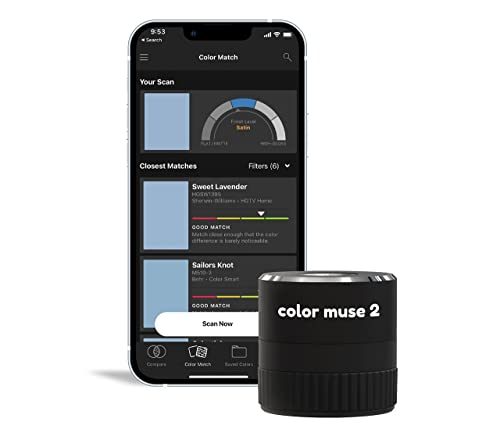
- Matches paint color and sheen
- Connects wirelessly to a color app
- Includes a broad brand color library
Best For: Wall-to-wall paint matching
Best Monitor Calibration Tool

- Uses a guided 1-2-3 workflow
- Supports up to two displays
- Includes before-and-after checking
Best For: Photo and video monitor calibration
High-Luminance Creative Pick – Calibrite Display Pro HL
For photographers and designers comparing colorimeter color calibration tools, the Calibrite Display Pro HL is a versatile choice for modern LCD, mini-LED, OLED, Apple XDR, and compatible projector workflows. Its sensor measures up to 3,000 nits, while PROFILER software supports detailed display adjustments and validation.
Best For: Creative professionals who need accurate profiling across bright displays and multiple workstations.
Pros:
- Supports high-luminance displays up to 3,000 nits, including HDR-capable panels.
- PROFILER software provides Basic and Advanced modes with custom presets and patch sets.
- Includes profile validation, uniformity checks, flare correction, and multi-monitor support.
- USB-C connectivity, USB-A adapter, travel pouch, and built-in 1/4-inch mount thread are included.
Cons:
- Its 3,000-nit measurement range is below the range of the Display Plus HL and SpyderPro.
- Advanced profiling features may be more than casual users need.
The Display Pro HL balances modern display support with practical verification tools. It is a strong middle-ground option for users who want repeatable color results without stepping up to an ultra-high-luminance instrument.
Portable Paint-Matching Pick – Datacolor ColorReader EZ
The Datacolor ColorReader EZ is a compact colorimeter color calibration tool for matching paint and capturing color inspiration rather than profiling a computer display. It connects to the ColorReader app over Bluetooth and provides brand paint matches along with CIELAB, RGB, and HEX data.
Best For: DIYers, decorators, and anyone who needs quick paint-color matching on the go.
Pros:
- Portable, battery-operated design weighs 1.76 ounces.
- Offers paint matches from leading brands and color values in CIELAB, RGB, and HEX.
- The iOS and Android app supports digital fan decks, color coordination, visualization, samples, saving, and sharing.
- Integrated calibration and tighter Delta E standards are designed to improve perceptual matching.
Cons:
- This is a paint and color-scanning tool, not a monitor calibration device.
- Requires the ColorReader app and two CR2032 batteries.
Choose the ColorReader EZ when your priority is translating real-world colors into paint matches and digital color data. Its focused app-based workflow makes it more suitable for home projects than professional screen profiling.
Extreme HDR Pick – Calibrite Display Plus HL
Among colorimeter color calibration tools, the Calibrite Display Plus HL is aimed at demanding HDR and video workflows. Its advanced high-luminance sensor measures up to 10,000 nits and works with LCD, mini-LED, OLED, Apple XDR, super-bright displays, and compatible projectors.
Best For: Video editors, colorists, and production teams calibrating very bright HDR displays.
Pros:
- Measures ultra-bright displays up to 10,000 nits for HDR calibration.
- Supports Rec.709 and BT.1886 tone-curve options for Rec.2020 workflows.
- PROFILER software includes custom patch sets, shared presets, and Basic and Advanced controls.
- Provides quick checks, profile validation, uniformity checks, and multi-monitor profiling.
Cons:
- The advanced feature set is likely excessive for basic office or casual display calibration.
- Its primary advantage is high-luminance capability, which may not be necessary for standard-brightness screens.
The Display Plus HL is the specialized choice for HDR-capable environments where ordinary calibration hardware may not cover display brightness. Its video-standard support and validation features also suit collaborative production setups.
Advanced Multi-Display Pick – Datacolor SpyderPro
The Datacolor SpyderPro is a feature-rich colorimeter color calibration tool for photography, design, video editing, and multi-screen setups. It supports displays up to 12,000 nits, a wide range of backlight technologies, projector calibration, display analysis, and 3D LUT export for compatible video monitors.
Best For: Professionals managing multiple displays, advanced tone controls, projector workflows, and video color standards.
Pros:
- Supports Wide LED, OLED, QD-OLED, Apple Liquid Retina XDR, Mini LED, and brightness up to 12,000 nits.
- Offers Standard Calibration in about 90 seconds plus a deeper calibration mode.
- Includes display mapping, uniformity and gamut analysis, CheckCal, StudioMatch, and SpyderTune.
- Supports Rec.709, Rec.2020, DCI-P3, projector calibration, and 3D LUT export.
Cons:
- The extensive controls and analysis features may create a steeper learning curve.
- Requires a nonstandard battery in addition to its USB-C connection.
SpyderPro stands out when calibration is part of a broader studio workflow rather than an occasional task. Its wide brightness range, display analysis, and multi-monitor tools make it particularly capable for users who need ongoing control over several screens.
Professional Capture-to-Display Kit – Display Plus HL Video Photo Kit
For creators comparing colorimeter color calibration tools, this Calibrite kit combines high-luminance monitor calibration with a camera reference system. The Display Plus HL supports panels up to 10,000 nits, while the ColorChecker Passport Video 2 helps establish white balance, exposure, and camera matching.
Best For: Photographers and videographers working with bright OLED, mini-LED, or Apple XDR displays who want a consistent capture-to-edit workflow.
Pros:
- Calibrates high-brightness displays up to 10,000 nits.
- Includes four camera reference targets for white balance, exposure, color, and grayscale checks.
- Supports consistent color management across cameras, monitors, and software on Windows and macOS.
Cons:
- Its camera-reference features may be more than casual monitor users need.
- PROFILER software requires a download.
This is the most complete option for professional photo and video workflows, especially when both on-set references and high-luminance display calibration matter.
Portable Surface Matching Tool – Nix Mini 3 Color Sensor
The Nix Mini 3 takes a different approach to colorimeter color calibration tools: it scans physical surfaces and returns matching paint or digital color values. It can identify matches from more than 300,000 paint colors and provide RGB, HEX, and CMYK values through its color-matching system.
Best For: DIYers, decorators, and professionals who need portable paint matching or quick digital color readings from physical samples.
Pros:
- Matches colors across a library of more than 300,000 brand-name paints.
- Provides RGB, HEX, CMYK, Pantone, RAL, and NCS color information.
- Dust- and splash-resistant with an IPX4 rating, and requires no calibration for ongoing scans.
Cons:
- Performance is better on matte samples than on all surface finishes.
- Paint libraries vary by country or region.
- It is designed for surface matching rather than display calibration.
Choose the Nix Mini 3 when your priority is translating real-world surfaces into paint or digital color codes, not profiling a computer monitor.
Classic Display Calibration Choice – Datacolor Spyder4Pro
The Datacolor Spyder4Pro is a dedicated display colorimeter for buyers seeking straightforward monitor calibration. Its full-spectrum sensor supports automated color and brightness calibration across multiple displays, while the ReCAL assistant helps simplify repeat calibration over time.
Best For: Users who want automated color and brightness calibration for multiple displays with a dedicated full-spectrum sensor.
Pros:
- Automates display color and brightness calibration.
- One sensor can calibrate multiple displays.
- ReCAL assists with faster recalibration as displays change over time.
- Double-shielded filters are designed for improved accuracy and long-term stability.
Cons:
- This is an older Spyder4Pro model and may lack the high-luminance support of newer tools.
- The supplied notes do not specify current operating-system compatibility.
The Spyder4Pro remains a focused choice for basic multi-display calibration, but buyers with very bright modern panels should compare its capabilities with newer colorimeters.
Best Paint Match Tool – Color Muse 2
For paint-focused color calibration tools, the COLOR MUSE 2 is designed to identify a close paint-color match from a flat surface and report sheen. Its wireless connection to the Color Muse app also provides access to colors from brands including Sherwin-Williams, Behr, PPG, and Benjamin Moore.
Best For: Homeowners and professionals matching wall paint colors and finishes for broad painting projects.
Pros:
- Identifies paint color and sheen, from flat or matte through high-gloss.
- Works with the Color Muse app over a wireless connection.
- Offers access to an extensive library of paint colors and select RAL and Pantone options.
- Compact design makes it convenient for on-the-go readings.
Cons:
- Not recommended for small spot touch-ups.
- Best results require smooth, flat surfaces.
- Phone-screen color displays may vary slightly from scanned colors.
The COLOR MUSE 2 is a practical choice when paint matching and sheen identification are the priority. Its stated accuracy is intended for wall-to-wall painting rather than precise touch-up work.
Best Monitor Calibration Tool – Calibrite Display 123
Among colorimeter color calibration tools for displays, the Calibrite Display 123 uses a guided 1-2-3 software workflow to help creators correct common monitor color shifts. It connects through USB-C, supports two displays, and includes a before-and-after comparison.
Best For: Photographers, video creators, and other users who need more consistent color across one or two monitors.
Pros:
- Guided setup is designed to make monitor calibration approachable.
- Supports calibration of up to two displays.
- Includes brightness target choices such as Native or Photo.
- Before-and-after checking helps confirm the calibration result.
Cons:
- USB-C connection may require an adapter for incompatible devices.
- Its focus is monitor calibration rather than physical paint or material measurement.
The Display 123 is a straightforward display-focused option for improving consistency during photo and video work. Dual-display support is especially useful for a multi-monitor editing setup.
Best Portable Color Difference Meter – 45/0 Portable Colorimeter
For portable color calibration tools used in field checks, this 45/0 color difference meter combines automatic calibration with support for several industry color-difference calculations. It can also match RAL and other color cards for quicker color selection.
Best For: On-site color checks, paint measurement, and users comparing colors against cards or standardized difference values.
Pros:
- Automatic calibration is designed to reduce measurement errors.
- Portable, lightweight form is suited to on-site use.
- Measures dEab, dEcmc, dE94, and dE00 color differences.
- Supports color-card matching, including RAL cards.
Cons:
- The supplied information provides limited details about the display, controls, or software.
- Its technical color-difference features may be more than casual users need.
This meter stands out for users who need numerical color comparisons in a portable format. Automatic calibration and multiple dE calculation options make it better suited to structured checks than simple visual color selection.
How We Picked These Colorimeter Color Calibration Tools
We selected tools across the main color-measurement use cases: monitor calibration, HDR and OLED display work, camera and video production, paint matching, and portable color comparison. We considered sensor capabilities, supported brightness ranges, software workflow, connection requirements, portability, durability, and the type of user each device serves.
Because a display calibrator and a paint scanner solve different problems, the most important comparison is intended use. A monitor colorimeter measures and profiles a screen; a paint colorimeter reads a physical sample and compares it with a color database. They are not interchangeable, even though both use color measurement technology.
Quick Comparison
- For everyday monitor calibration: Look for a simple USB-connected colorimeter with guided software, such as an entry-level Display model.
- For bright HDR, Mini LED, or OLED screens: Choose a device with a high-luminance sensor designed for modern displays.
- For photographers and editors: Prioritize profiling software, repeatable results, and compatibility with your operating system and editing workflow.
- For video production: A kit that combines display calibration with a camera color chart can cover both monitoring and capture consistency.
- For paint matching: Portable tools from ColorReader, Nix, or COLOR MUSE are designed for surfaces rather than screens.
- For technical color checks: A portable color-difference meter may be better suited to quality control than general home use.
Key Buying Factors for Colorimeter Color Calibration Tools
Display Type and Brightness
Check whether the tool supports LCD, Mini LED, OLED, and HDR displays. Older or basic sensors may not be ideal for screens with very high peak brightness. If your monitor reaches several thousand nits, select a model explicitly rated for that range.
Software and Workflow
The sensor is only part of the system. Good calibration software should guide setup, account for ambient conditions when appropriate, create a monitor profile, and make it easy to verify results. Confirm support for your operating system and preferred color-managed applications.
Accuracy Versus Convenience
Professional users may need repeatability, advanced controls, and support for multiple displays. Casual users may benefit more from a fast, guided process than from extensive manual settings. Decide how often you will calibrate before paying for features you will rarely use.
Portability and Surface Compatibility
For paint and material matching, consider device size, app connectivity, database coverage, splash or dust resistance, and the surfaces the sensor can read reliably. A compact scanner is convenient, but database limitations can affect the availability of exact matches.
Who Should Buy Which Colorimeter Color Calibration Tools?
Photographers and graphic designers should choose a dedicated monitor colorimeter with dependable profiling software. Video editors and HDR professionals should favor high-brightness support or a production kit that includes a camera chart. Home decorators and paint retailers should choose a paint-matching scanner with a useful brand database and a straightforward mobile app. Field technicians and quality-control users should look for a portable color-difference meter with the measurement modes and repeatability their process requires.
Before buying, verify the software platform, connector type, display technology support, and whether the device is intended for screens or physical materials. Matching the tool to the measurement task is the best way to get useful, repeatable color results.